Unlock the power of your video data

Turn driving videos into actionable insights with AI-powered analysis

AI that can grasp complex scenarios

Our AI pipeline extracts rich data from a variety of scenarios.

Context understanding

Understands the driving environment

Behavior analysis

Detects the precise actions take by the driver

Incident accountability

Helps analyze and identify fault in incidents

Scenario reporting

Generates brief reports to summarize incidents

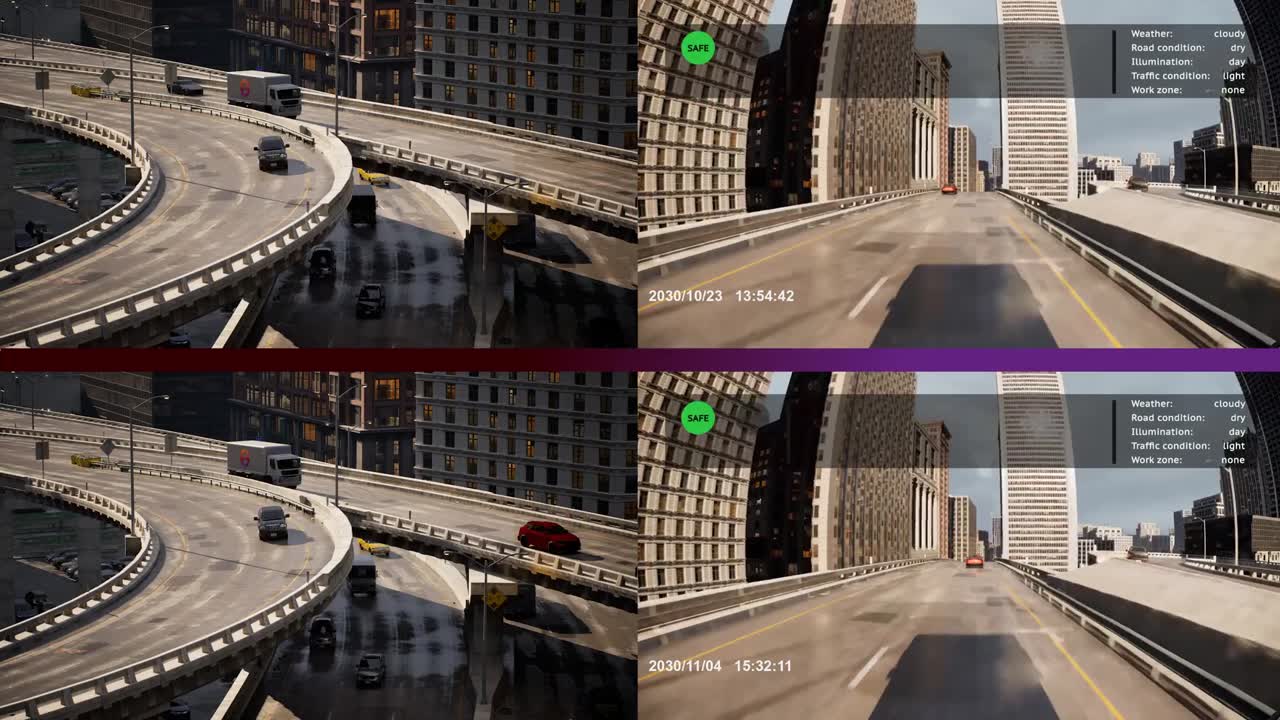
AI that understands why

Same event; different context. 
Two vehicles can perform identical driving maneuvers, while one drives aggressively and the other drives safely.

Automated reports tailored to customer-specific needs


Our AI transforms this video footage into behavioral insights and interprets the reasoning behind the driving maneuvers, generating tailored reports for drivers, employers (e.g. fleet owners), and insurers.

Select a report to view from the tabs above.


Event summary:

A bicyclist unexpectedly moved into your lane, prompting a "Bicyclist in Danger" alert. You responded appropriately with an initial brake to avoid immediate harm. However, a second alert was triggered shortly after because the vehicle followed the bicyclist too closely, despite having time to slow down and increase following distance. The road was also detected as wet during the incident.

Driver evaluation:
Your quick initial reaction helped avoid a potential collision and was appropriate. However, continuing at close range behind the bicyclist—especially in wet conditions—posed a preventable risk.

Advice:
After an evasive maneuver, especially in bad weather, it’s crucial to slow down more and allow additional space for vulnerable road users. Wet roads reduce traction and increase stopping distance. Maintain a wider buffer to improve safety and reduce the need for further risk corrections.

Incident Overview:
Two "Bicyclist in Danger" alerts occurred. The first was due to an unexpected bicycle maneuver, to which the driver reacted appropriately. The second alert followed as the vehicle closed distance with the cyclist without sufficient deceleration. Wet road conditions were also detected at the time, increasing potential risk.

Driver Performance Evaluation:
- Initial Response: Appropriate
‍- Post-Event Adjustment: Inadequate
‍- Risk Assessment: Moderate
‍- Driver Risk Rating: Below average

Employer Guidance:
This driver handled the initial hazard correctly but demonstrated poor follow-through in a wet road scenario by not increasing distance. For professional drivers, maintaining safe margins—especially around vulnerable road users—is critical. Recommend refresher training on defensive driving and adapting behavior based on weather conditions.

Event Analysis:

Two "Bicyclist in Danger" events were recorded during a single encounter. The first resulted from the bicyclist unexpectedly entering the vehicle's path, and the driver reacted appropriately. The second occurred after the vehicle had time to reduce speed and increase following distance but failed to do so. The system also detected wet road conditions, which further raised the risk profile.

Driver Behavior Rating: Mixed
- Risk Created: Elevated (unsafe proximity in poor weather)
- Risk Mitigated: Partial (good initial braking)
- Environmental Factors: Wet roads necessitate increased caution
- Driver Safety Profile Impact: Moderate negative impact

Insurance Insight:
While the driver avoided an initial collision, failure to maintain a safe distance after the incident increased risk. This behavior indicates room for improvement in hazard anticipation and space management, which may slightly raise risk profiling in insurance calculations.
Our AI transforms this video footage into behavioral insights and interprets the reasoning behind the driving maneuvers, generating tailored reports for drivers, employers (e.g. fleet owners), and insurers.

Select a report to view from the tabs above.


Event Summary:
A harsh braking event was detected due to a pedestrian suddenly entering the roadway while you had the right of way and the traffic light was green. The system classified the situation as an emergency where a “Pedestrian in Danger” alert was triggered.

Driver Evaluation:
Your quick response helped avoid a potential collision and protected the pedestrian. While the braking was harsh, it was necessary and appropriate under the circumstances. You were not speeding and had legal right of way.

Advice:
This situation was unpredictable, but always remain alert near intersections and be prepared for unexpected pedestrian behavior—even when you have the green light. Proactive scanning and controlled speed can help reduce the need for harsh braking in such scenarios.

Incident Overview:

A harsh braking incident occurred at an intersection where a pedestrian unexpectedly entered the roadway. The vehicle had a green light and was within the speed limit. The driver reacted quickly, triggering a “Pedestrian in Danger” alert.

Driver Performance Evaluation:
- Right of Way: Maintained
- Speed Compliance: Within limit
- Reaction Appropriateness: High
- Harsh Brake Justification: Valid emergency
- Driver Risk Rating: Low

Employer Guidance:

This incident does not indicate reckless or negligent behavior. The driver's actions align with those of a skilled and attentive professional. No disciplinary action is recommended. Overall, this driver demonstrates good situational awareness and decision-making under pressure.

Event Analysis:
A harsh braking event was logged due to a pedestrian suddenly entering the vehicle’s path at a green light intersection. The vehicle was traveling within the legal speed limit and had the right of way.

Driver Behavior Rating:
Positive
- Risk Created: Minimal (pedestrian at fault, not the driver)
- Risk Mitigated by Driver: High (collision avoided through rapid response)
- Driver Safety Profile: Improved by incident (demonstrated defensive driving)

Insurance Insight:
The driver's behavior reduced potential risk and showed prompt reaction in an unexpected scenario. This suggests a low-risk driving profile and supports favorable insurance consideration.

A platform that can meet the demands of modern business

Engineered for unmatched speed and precision, our AI-driven platform empowers businesses to automate video analytics with your existing hardware. Built on a scalable tech stack, our platform leverages machine learning and computer vision to deliver real-time insights, saving companies $1,500 per vehicle annually.

Agnostic solution adapts to any camera system

Our software automatically adapts to your existing camera solution's extrinsic and intrinsic camera parameters so you don't need any new hardware onboard.

Your data is safe and secure

We prioritize data security and privacy. Our system only records safety-critical events, and all video is abstracted during post-processing to protect driver identities. You can trust that your data is handled with the utmost care.

Understand the reason for your driver's actions with superior recognition

Our advanced context recognition goes beyond simple event detection. We identify surrounding circumstances to give you a complete picture of driver behavior, allowing you to pinpoint the root causes of risky driving and implement targeted coaching to improve safety and reward good driving.

Accurately capture the complexity of driver behavior

Our high-accuracy analysis minimizes false positives, so good drivers aren't unfairly penalized. This reliable data enables you to create detailed driver profiles, identify areas for improvement, and make data-driven decisions that boost safety and efficiency.

Application areas

An example image showing fleets.

Fleets

Effortlessly identify risky driver behavior, saving fleets thousands of dollars annually through driver coaching and optimization.

An example image showing a rear view mirror. This is used to show a relevance to an insurance market.

Insurance

Easily contextualize driver behavior, allowing good drivers to be rewarded for appropriate behavior on the road.

An example image showing a car. This image is used to show a relevance to vehicle validation.

Vehicle Validation

Reliably test vehicle ADAS behavior through context analysis and data labeling.